
Digital humanities is the application of digital tools to the traditional areas of the humanities, as well as the study of digital history. In this case, for a digital humanities class at Michigan State, I used respected digital studies tools to do something akin to literary analysis on a set of oral histories. I then analyzed my findings and drew conclusions that could be applied to everyday life.
Initial Brainstorming
When given the option of ‘anything’, it can be hard to wind down your options. As a public relations major, many of the traditional questions of the humanities tend to seem- foreign, almost. I love quilts, but I’m probably not the person to investigate Russian quilting methods from the years 1440 to 1540. At the same time, what’s the point of doing a project just to get it over with? I wanted to do something that had meaning, both to others and to myself. I had some ideas, based on some things I’d heard, but nothing that felt right.
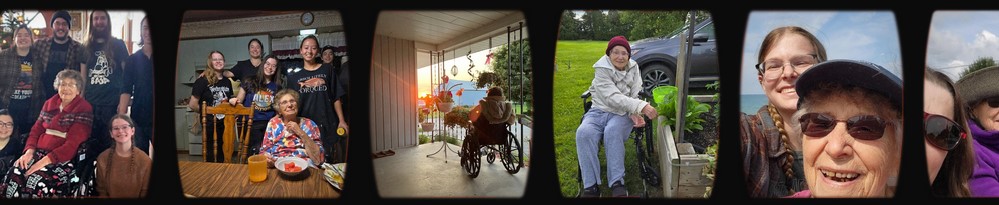
Unfortunately, a week later, I found myself in a place dredged in meaning. My grandmother (the lovely Margaret Jones) had passed recently, and the more I listened to people talk about her, the less I understood the words they chose to use. I wanted to know why the way we spoke of her had changed- so here this was. A golden opportunity to try and find out.
Research Question & Scope
Initially, I started with ‘How do we speak of our dead?’. But, of course, that is a question that could be built on endlessly. After listening to experts in the field discuss their projects, I knew I had to manage my scope creep. I narrowed it in two ways.
A) The topic: Just those we knew, not all of our dead.
B) The speakers: Just those at MSU, not all of the world.
This allowed me to have a good base of interviewees, as this was my community base, as well as speak to people who really had things to say on the topic. Hopefully, people would be more eager to speak about their loved ones, rather than some celebrity they thought they knew.
Our research question was now: “How do the faculty and students of Michigan State University talk about the passing of those they knew?”
Interview Process
- Questions
Before I even considered what I wanted to ask, I turned to research. I looked to similar projects in the field, and read journal articles on oral history best practices. Death is a sensitive subject. How I approached it when talking to others was important, and not just to my results. Eventually I landed on a few that would allow my interviewees to become relaxed in our conversation, and to lead it in their own way.
- Consent form
Similar to focus group consent forms, I covered myself legally by having each interviewee sign a waiver-like document. There was also a section for demographic information, allowing me to have a disconnected understanding of who I was talking to. This helped when evaluating for any bias: I went into detail about who I reached on the site itself.
- Meeting itself
Each meeting was between 14 and 48 minutes long. To keep them all consistent, they were all done virtually.
- Transcription
Using Descript and the recordings, I created an initial transcript using AI technology. Afterwards, I listened through each interview carefully and adjusted for anything that was missed.
Analysis
- Atlas.Ti
- Used for coding purposes
- Hand-coded each transcript, allowing the codes to come from the text itself
- Focusing on the subject of the speech, and not the emotion
- Voyant
- Used for text analysis purposes
- Looking for commonly used words & common topics
- Context to each word- how were the words used?
- Flourish
- Used for creation of the bar graphs
- Purely visualization creation
Building of ‘Site’
- Finding the audience
As death can be a niche subject, I wanted to ensure I was on the right platform. A MSU-based website would be taken down a year after I graduated, and some random Google site might never see the light of day again. I need an archival-based digital humanities platform: thank goodness, I happened to work for just that.
H-Net: Humanities & Social Sciences Online is dedicated to developing the enormous educational potential of the Internet and the World Wide Web. I’ve worked with them for quite some time, and I knew their user base would welcome a subject like this. More, specifically, they had a network named H-Death. So. It sounded solid.
- Reaching out to H-Death editors
As each network is moderated by a group of volunteers, I need to get permission first. I contacted Kim Woodring, told her my plans, and she agreed to have the project hosted on the network.
- Built out my site
There are other successful projects on H-Net already. I took to those to create the initial set up of Speak of the Dead. For the information itself, I looked to other digital humanities projects we’d analyzed over the course of the semester. For example, I knew I needed quite a lot of context, and that including the data would be helpful for those looking to make their own works.
Then, I built it out on a testing area. When completed, I ran it past Kim, and with her enthusiastic consent, published it.
Finished Product/Findings
As taken from my site:
When you ask me about someone’s passing, and I start talking about the death rattle and clammy hands, there will be an instinct to say ‘God, that’s okay, you don’t have to talk about it’. We, specifically as a Western culture, have a tendency to almost deny death itself. ‘Pass on’. ‘Moved on’. ‘No longer with us’. Someone straight up dying– even in their own home, in their sleep– is tinged with an intensity that is often shied away from.
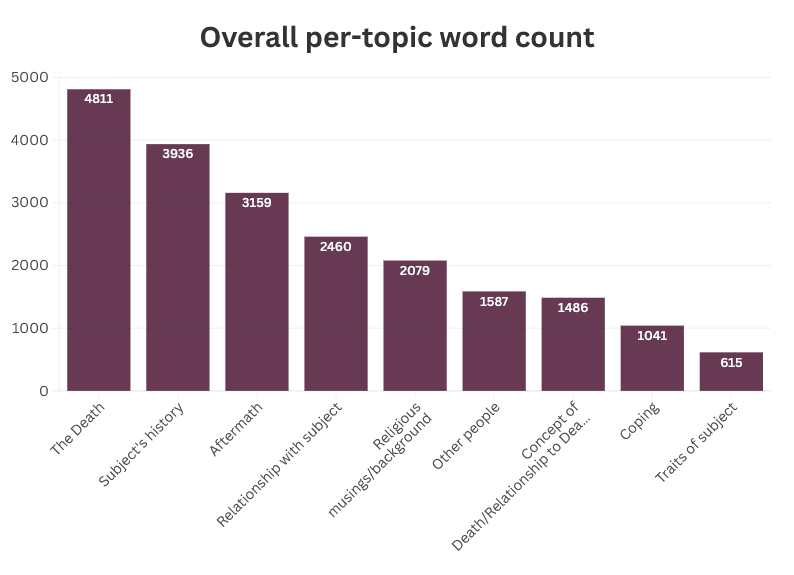
But when given a space free of judgement, the death itself is something we focus on the most. Perhaps it’s important for us to allow each other to speak of these moments, to work them out aloud.
As many of the interviewees mentioned, we don’t get a chance to talk through it very often. Especially not when the people most open to speaking of it (our families) were already there, and already know the details.
But clearly, it is important. It’s important to talk of their death, of their life, and of the impact it left behind.
We focus on who they were, what they did, the people around them. We try to get across the all of it all, seek out reassurances that this makes sense, right?
This space, this topic, is an important one to allow into conversation, in any way that it is said.