
Optimizing Book Ordering @ H-Net
(Context)
H-Net is a non-profit digital humanities website that supports the community of over 230,000 people across the world. It hosts around 200 networks of various topics, allowing academics to build on each other’s knowledge, share resources, and more. One of the integral aspects is their book review system. We allow individuals to review books at no personal cost, which supports the author as well as the reviewer’s personal career.
Step 1: Finding a Place for Improvement
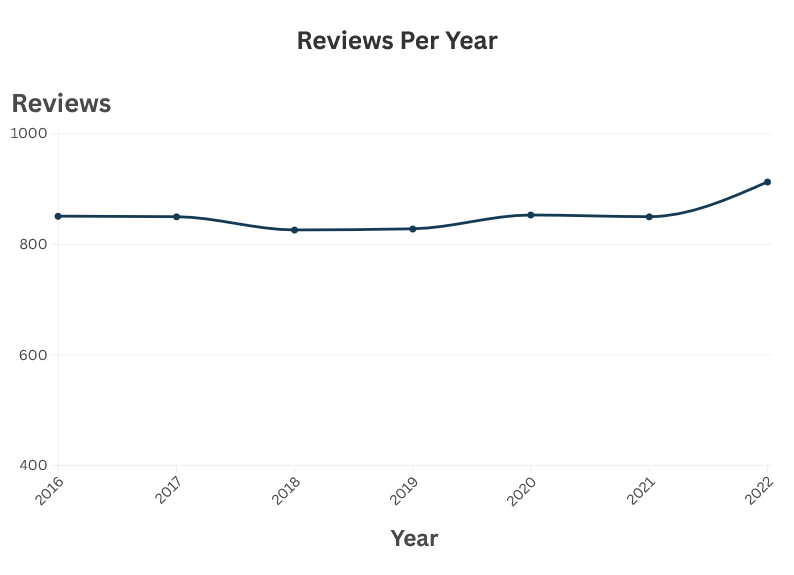
Blessedly, within H-Net system was a way to see how many reviews are published each year. When I found myself curious about improving the system, I took to this space first. What I found was a slump. We’d sat at around 850 for about six years- even including the pandemic, this was something to look further into. No negative change, but no positive change.
At the time, there’d also been an update in our commons, where reviews are viewed, so there should have been some amount of change. Something must have been going on with our ability to process and publish our reviews.
Step 2: Recording Current Issues
In order to do my part to help the reviews process grow, I took to a few careful tasks.
- Monitoring publisher responses for feedback
- We receive our copies for free from these places- their experience with our system was vital
- Talking to team lead & coworkers about their experiences
- Emily Elliott, Associate Director for Research and Publications, had vital info for my efforts
- Recording any issues that arose
- In an organized document within our shared Drive space
Step 3: Systematic Change
After seeing that there was an opportunity, and recording the details of what could be improved, I moved onto what I could do to help. These efforts can be summed up into three key areas.
One: Organization
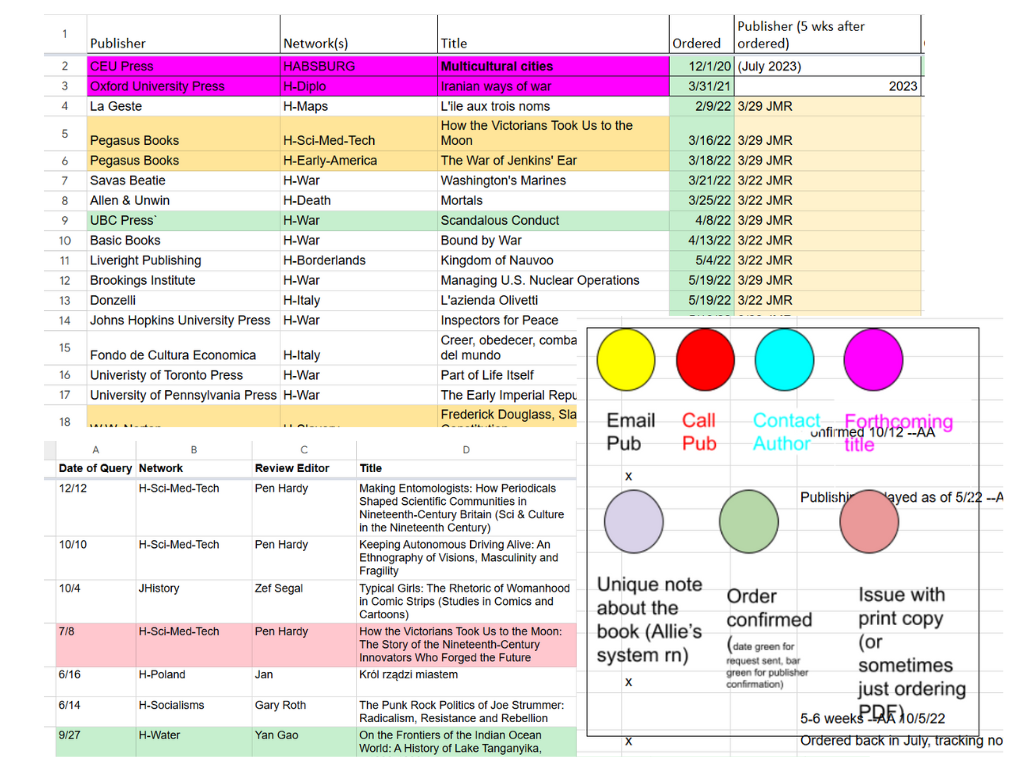
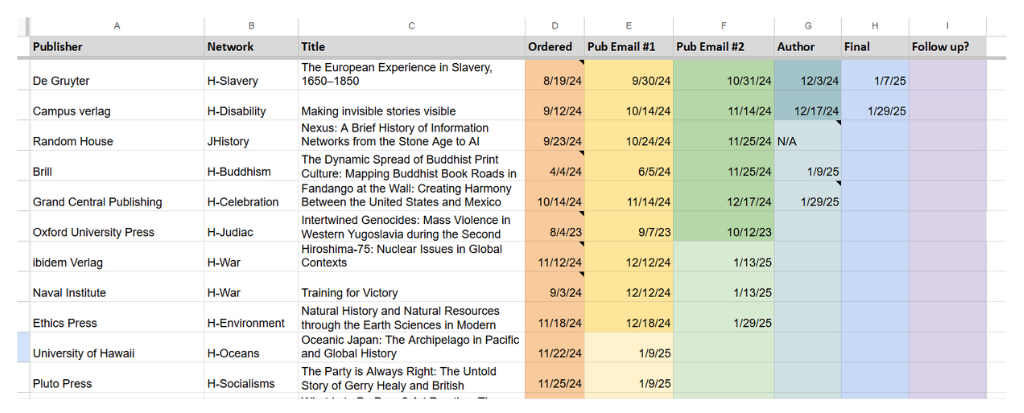
The book order sheet, which we used to track our review editor’s requests, was a small nightmare to see. There was a keycode somewhere in the distance, bold boxes everywhere… so the first step was to slim it down. Color-coding for speed (each color being a different stage), adding standardized note systems, creating formulae for automatic updating and warnings, and more.
Two: Communication
Changing the way we approached our publishers was necessary for furthering our relationships. More friendly text, adding any helpful details ahead of time, and following up on old emails instead of creating new chains. Also, having one person they knew the name of, instead of just ‘H-Net Staff’. We also changed how we sent emails to more suit their timelines.
In addition, I began adding more details into our records for our requestors to see. This allowed them to know ahead of time what they were getting into, instead of finding our three weeks later when they were emailed about it.
Three: Continual Progress
The issue resolution didn’t stop there. I continue to record every issue we come across, especially details that I cannot change on my end. I also joined H-Net’s Reviews Committee to help implement the necessary solves in the upcoming website update, advocating for our publishers and reviewers with my gathered data and concerns.
Step 4: Positive Results
The reviews per year have reached over 1,000 for the first time since 2009. Our pending orders have decreased over 70% total.
We have made genuine relationships with our publishers (Gigi from University of Pennsylvania (now Indiana) I see you!) instead of bland form letter communications.
We will continue to improve our reviews system by creating a new site for it that will allow for easier writing, editing, ordering, and more.